

Banddirector.com - The #1 Online Resource for Band Directors!

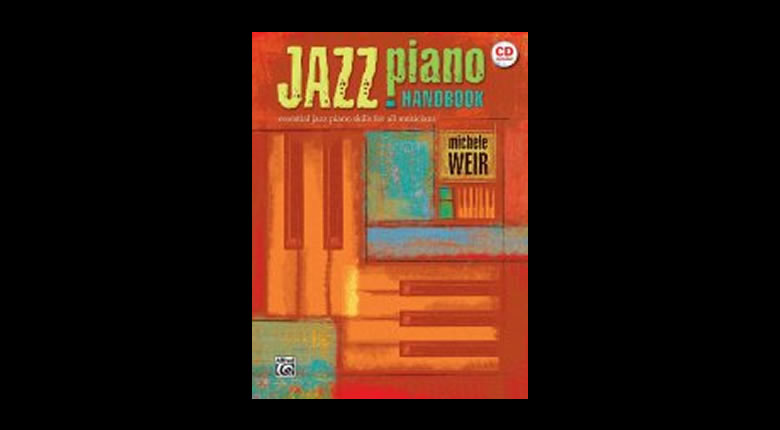
JAZZ PIANO HANDBOOK
(Essential jazz piano skills for all musicians)
Michele Weir
©2008 Ballwin-Mill Publishing Corp.
A division of Alfred Publishing Company 
List price $29.95
 Reviewed by Vince Corozine
 
            Within the125 pages of information on how to play jazz piano, there are many “white” space areas which ensures easy reading. Numerous musical examples strengthen the author’s presentation.
 
            The author lists two musical prerequisites for the reader.
(1) the need to have a basic familiarity with the piano and (2) a solid understanding of music fundamentals, to include the following:
Key and meter signatures
Major and minor scales
 
Intervals
 
Triads: major, minor, augmented, and diminished
 
Understanding of counting of basic rhythms
 
            The information “What Will I Learn?” contained on page 2 is most helpful.  The author presents eleven skills that the reader will learn by studying, playing the examples contained in the book and listening to the examples  presented on the accompanying CD.
 
            The book is clearly written and carefully designed to give the novice pianist or arranger maximum exposure to playing jazz piano.
 
            Part I “The Essentials” presents various chord voicings, chord progression patterns, and rhythmic styles. While Part II “Above and Beyond” brings forth color notes, more complex chord voicings, pianistic textures (open voicings), broken chords, passing tones, and fills.
 
            Appendix I presents fourteen etudes based on the chord progression of jazz standards, like “How High the Moon,” “All the Things You Are,””When I Fall In Love” “Lullaby of Birdland” and others.
 
            Appendix II is a catalog of chord symbols and color notes (high-tension notes), followed by a glossary of jazz terms.
 
            The strong points of the book are:
 
The play exercises employ different types of voicings in all keys.
 
The CD is of excellent tonal quality, performed well, in a smooth connected manner.
 
Each exercise is marked with an icon such as “Play Exercise, Listen to CD, and
      Study Example.  This visual highlight immediately tells the reader what is
      expected of him or her regarding each exercise.
 
The page “The Reality of Practice” is excellent for helping the reader set short
      and long-term practice goals.
 
“Before You Begin: Piano Review” is designed to assist the non-pianist by imparting basic information such as: reminding the player about the proper playing positions regarding fingers, wrist, and shoulders
 
There are numerous TIPS (highlighted in shadow boxes) for quick recognition.  The approximately thirty-five “tips” are very helpful.
 
 The chord progressions are logical, jazz-oriented, and contemporary sounding.
       A close study of the chord voicings and inner-voice movement  in the fourteen etudes in Appendix I are an excellent study for fledgling pianists or arrangers.
 
8.   Chapter 5 brings forth an excellent approach regarding the writing and playing of            jazz (walking) bass lines.  A few of the etudes illustrate the good use of walking bass lines as well.
 
9.   The author selected familiar jazz standards.These are tastefully handled and        presented in a variety of keys and tempo settings.
 
10. Chapter 5 “Rhythmic Styles” is particularly helpful to the young pianist or
      arranger.
 
      I recommend this book for pianists and arrangers who wish to improve their understanding of basic jazz piano voicings, to improve their piano playing facility, and to listen to a CD that offers contemporary piano styles.
 
       The author could have expanded the following:
1. The exercises presented early in the book use predominately chords written half notes or whole notes. After the student begins to grasp these patterns, the author could offer suggestions for “comping” patterns, particularly in the etudes. Half of the 14 etudes did show “comping” patterns and these were done with excellence. Suggesting “comping” patterns for all of the etudes would definitely strengthen the author’s presentation.
 
2. Under “The Nature of Chord Progressions,” the author might have mentioned the four most common ways that jazz chords progress:  a. Circle of Fifths (All the Things You Are), 2. Chromatic (A Fine Romance, One Note Samba, Lover), 3. Diatonic (That’s All, Bewitched, It Never Entered My Mind), 4. Tri-tone (Well, You Needn’t) or show how the tri-tone is used as a substitution: (Out of Nowhere, Bye Bye Blues, Lady Is a Tramp).
 
3. The reader would be enlightened if the basic song form construction were indicated for each song, such as AABA, ABAB, ABAC, and AAB and so on.
 
4. Demonstrating that chord progressions can be named using enharmonic equivalents such as, G#m7 (Abm7), C#7(Db7)  F#maj7 (Gbmaj7). This will assist the reader to think in both sharp and flat keys.
 
      It appears that a second book could incorporate some of the above suggestions. Perhaps Book II could include areas such as pedal-points, modal scales, suspensions, pentatonic, whole tone and diminished scales (two types) and extended endings. Since the author has outstanding credentials, it is no surprise that this handbook is impressive and well executed.
 
This is an excellent book for the beginning pianist or fledgling arranger. The chord changes, voicing patterns and “comping” patterns are very helpful. The CD is a good way to “stretch” one’s ear to hear new contemporary sounds.  As an arranger I recommend this book to all pianists and arrangers.
 
 
Vince Corozine Music , Author of "Arranging Music for the Real World" by Mel Bay Publications

Web: www.vincecorozine.com
e-mail: vince@vincecorozine.com
(845) 208-3381
10 Veschi Lane North
Mahopac, NY 10541